Women Rights In Turkey

In its less visible, more subtle forms, gender-based violence threatens the physical and emotional integrity of millions of women living in Turkey, and billions globally

TURKISH - CHINESE RELATIONS SINCE 1971 AND THE EAST TURKISTAN ISSUE

Turkish and Chinese people have historical relations since the periods of the Hun Empire and Göktürks. These relationships are driven, sometimes friendly and sometimes went to war in the history

Showing posts with label european studies. Show all posts

Monday, July 8, 2013

Dramatic History of Europe and the Emergence of the European Union


Europe is one of the world's seven continents where approximately 740 million people living in. It is the world's second-smallest continent by surface area, covering about 10,180,000 square kilometres (3,930,000 sq mi) or 2% of the Earth's surface and about 6.8% of its land area. Everything in this small continent was not nearly as positive and stable, because there was seen at least one major war between nations of Europe in every hundred years 
World War II Deaths
Before the establishment of the European Union, it is known that the nations of Europe fought constantly with each other. In fact, some of the largest and bloodiest wars in the history of the world has existed on this continent such as World War I, World War II, Thirty Years' War, Napoleonic Wars, and French Wars of Religion.  

Franco-German Wars
In addition, France and Germany fought three times between 1870 and 1945. With the end of the Second World War in Europe, millions of people have died, and the states of Europe had collapsed economically.

Finally people understood that the wars between the European nations always damaging to Europe.

At this point, the idea of ​​the unity of the European states began to emerge.

In the 17th century, Immanuel Kant, Saint Simon, Wiliam Penny, Maximillian Jully and Victor Hugo that make up the infrastructure of this idea, and believes that one day the European union would be realized.

In fact, in 1856, by the Treaty of Paris was signed by five European countries, an alliance which is called as the Concert of Europe was founded.

The term of "United States of Europe" which was invented during the 19th century, and frequently used by the Austrian statesman Coudenhove-Kalergi, and French politician Briand in the 20th century.

Of course, all of these efforts collapsed with the rise of fascism especially in Germany and Italy in the 1930s. After the World War II, European people united around the idea of "Never Again War". 

In addition to the social and economic reasons, another factor for the acceleration of the process of formation of the European Union has been the aggressive policy of the Soviet Union.

Zürich, Switzerland
The term "United States of Europe" was used also by Winston Churchill in his speech delivered on 19 September 1946 at the University of Zürich, Switzerland. In this speech given after the end of the Second World War, Churchill concluded that:

"We must build a kind of United States of Europe. In this way only will hundreds of millions of toilers be able to regain the simple joys and hopes which make life worth living".


In 1949, the Council of Europe was founded . It is an international organisation promoting co-operation between all countries of Europe in the areas of legal standards, human rights, democratic development, the rule of law and cultural co-operation. It has 47 member states with some 800 million citizens.


Jean Monnet Father of Europe
Of course we should not forget the efforts of Jean Monnet who is the father of Europe. Following World War II, France was in severe need of reconstruction and completely dependent on coal from Germany's main remaining coal-mining areas, the Ruhr and Saar areas. In 1945 Monnet proposed the Monnet Plan, also known as the "Theory of l'Engrenage" (not to be confused with the Schuman plan). It included taking control of the remaining German coal-producing areas and reditecting the production away from the German industry and into the French, thus permanently weakening Germany and raising the French economy considerably above its pre-war levels. The plan was adopted by Charles de Gaulle in early 1946.

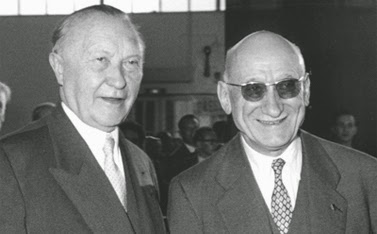
Konrad Adenauer & Robert Schuman
When tensions between France and Germany rose over the control of the then vital coal and steel industries, Monnet and his associates conceived the idea of a European Community. On 9 May 1950, with the agreement of Chancellor Konrad Adenauer of West Germany, French Minister of Foreign Affairs Robert Schuman made a declaration in the name of the French government. This declaration, prepared by Monnet for Schuman, proposed integration of the French and German coal and steel industries under joint control, a so-called High Authority, open to the other countries of Europe. Schuman declared:
"Through the consolidation of basic production and the institution of a new High Authority, whose decisions will bind France, Germany and the other countries that join, this proposal represents the first concrete step towards a European federation, imperative for the preservation of peace."
European Coal and Steel Community
When Germany agreed to join the European Coal and Steel Community according to the Schuman Plan in 1951, the ongoing dismantling of German industry was halted and some of the restrictions on German industrial output were lifted. West Germany joined the ECSC, alongside Italy, Belgium, Luxembourg and the Netherlands, while Britain refused, on grounds of national sovereignty. In 1952, Jean Monnet became the first president of the High Authority and with the opening of the common market for coal under the ECSC in 1953, the last civilian production limitations placed on German industry were lifted, and the role of the IAR was taken over by the ECSC.

European Coal & Steel Community Flag
The ECSC was first proposed by French foreign minister Robert Schuman on 9 May 1950 as a way to prevent further war between France and Germany. He declared his aim was to "make war not only unthinkable but materially impossible." The means to do so, Europe's first supranational community, was formally established by the Treaty of Paris (1951), signed not only by France and West Germany, but also by Italy and the three Benelux states: Belgium, the Netherlands and Luxembourg. Between these states the ECSC would create a common market for coal and steel. The ECSC was governed by a "High Authority", checked by bodies representing governments, MPs and an independent judiciary.
The ECSC was joined by two other similar communities in 1957 with Treaty of Rome, EEC and EURATOM, with whom it shared its membership and some institutions. In 1967 all its institutions were merged with that of the European Economic Community (EEC, which later became part of the European Union), but it retained its own independent identity.

The Merger Treaty (1967) (or Brussels Treaty) was a European treaty which combined the executive bodies of the European Coal and Steel Community (ECSC), European Atomic Energy Community (Euratom) and the European Economic Community (EEC) into a single institutional structure.

On 1 July 1968, six countries – Belgium, France, Germany, Italy, Luxembourg and Holland – abolished the last duties on goods movements among themselves, creating a European customs union. Besides doing away with trade barriers between member countries of what has become the European Union, the customs union established a common tariff on all goods entering these countries.


Charles de Gaulle

French president Charles de Gaulle strongly resisted, arguing that the UK was closer to American policies than European ones, and would therefore attempt to "sabotage" the community. Consequently, France vetoed the UK's first attempt at achieving membership in 1963, and in 1967.

Of course, the expansion of the 1970s and 1980s, was important steps for the European Union. In 1973, the Communities enlarged to include Denmark (including Greenland, which later left the Community in 1985), Ireland, and the United Kingdom. Norway had negotiated to join at the same time, but Norwegian voters rejected membership in a referendum. In 1979, the first direct, democratic elections to the European Parliament were held. Greece joined in 1981; Portugal and Spain in 1986. In 1985, the Schengen Agreement led the way toward the creation of open borders without passport controls between most member states and some non-member states. In 1986, the European flag began to be used by the Community and the Single European Act was signed.

The Single European Act (SEA) was the first major revision of the 1957 Treaty of Rome. The Act set the European Community an objective of establishing a Single market by 31 December 1992, and codified European Political Cooperation, the forerunner of the European Union's Common Foreign and Security Policy. It was signed at Luxembourg on 17 February 1986, and at The Hague on 28 February 1986. It came into effect on 1 July 1987, under the Jacques Delors Commission.

Helmut Kohl & François Mitterrand
The European Union was formally established when the Maastricht Treaty—whose main architects were Helmut Kohl and François Mitterrand. 1992-1993 The Maastricht Treaty (formally, the Treaty on European Union or TEU) was signed on 7 February 1992 by the members of the European Community in Maastricht, Netherlands. On 9–10 December 1991, the same city hosted the European Council which drafted the treaty. Upon its entry into force on 1 November 1993 during the Delors Commission, it created the European Union and led to the creation of the single European currency, the Euro. The Maastricht Treaty has been amended by the treaties of Amsterdam, Nice and Lisbon


In 1995, Austria, Finland, and Sweden joined the EU. In 2002, Euro banknotes and coins replaced national currencies in 12 of the member states. Since then, the Eurozone has increased to encompass 17 countries. In 2004, the EU saw its biggest enlargement to date when Cyprus, the Czech Republic, Estonia, Hungary, Latvia, Lithuania, Malta, Poland, Slovakia, and Slovenia joined the Union. On 1 January 2007, Romania and Bulgaria became EU members. In the same year Slovenia adopted the euro, followed in 2008 by Cyprus and Malta, by Slovakia in 2009, and by Estonia in 2011.

On 1 December 2009, the Lisbon Treaty entered into force and reformed many aspects of the EU. In particular, it changed the legal structure of the European Union, merging the EU three pillars system into a single legal entity provisioned with a legal personality, created a permanent President of the European Council, the first of which was Herman Van Rompuy, and strengthened the High Representative, Catherine Ashton.

Herman Van Rompuy & Catherine Ashton


The European Union received the 2012 Nobel Peace Prize for having "contributed to the advancement of peace and reconciliation, democracy, and human rights in Europe." On 1 July 2013, Croatia became the 28th EU member.
 
Although the monetary union has been shaken by the European sovereign-debt crisis since 2009 and Accession of Cyprus to continue the controversial, the European Union still has its own unique and unparalleled in the world. Thanks to the European Union, bloody wars ended in Europe today.

Monday, February 13, 2012

Yesterday and Today in the European Union: The First Enlargement of the European Communities


Introduction

This article focus on European Communities. Firstly, it tries to explain the beginnings of integration after Second World War. After that, it give information about European Communities such as European Coal and Steel Community (ECSC) and European Economic Community (EEC). Finally, I analyzes the first enlargement of European Communities. In addition, it gives some information about establishment of the European Union.

The Beginnings of Integration after World War Two in Europe


If people look the political history of Europe, they will see wars between European countries. After Second World War, there was a destroyed Europe. Whole Europe had damaged or destroyed as financial, social and political. This war was the biggest one and it was bigger than First World War. In Second World War, millions of people were dead in Europe so Europeans wanted to stop these wars and permanent peace in Europe so providing peace between European states was very difficult.


In 20 September 1946, Winston Churchill made a special speech at the University of Zurich in Switzerland. According to Churchill, “The first step in the re-creation of the European Family must be a partnership between France and Germany. In this way only can France recover the moral and cultural leadership of Europe. There can be no revival of Europe without a spiritually great France and a spiritually great Germany. The structure of the United States of Europe, if well and truly built, will be such as to make the material strength of a single state less important. Small nations will count as much as large ones and gain their honor by their contribution to the common cause. The ancient states and principalities of Germany, freely joined together for mutual convenience in a federal system, might take their individual places among the United States of Europe.” This means that Europeans must build a kind of United States of Europe so this makes the speech very important because it was first signal of integration of Europe.


This speech became very effective on European countries and in 5 May 1949 the Council of Europe was established by treaty of London.
Winston Churchill was a very important man for the process of integration of Europe but there were other actors for this process. They were German Prime Minister Konrad Adenauer, Italian Prime Minister Alcide de Gasperi, the Belgian Leader Paul Henry Spaak and French Foreign Minister Robert Schuman. There is no doubt that they are very important men for the integration process. There was also Jean Monnet who was known as the father of Europe. In 1950, Jean Monnet persuaded the French foreign minister Robert Schuman for declared a plan to a pooling of Europe` s coal and steel resources. In 1951, six countries signed the Treaty of Paris that establishes the European Coal and Steel Community. After that integration between European countries developed and now Europe has a strong union which is European Union.


European Communities after Second World War


After Second World War, European Integration started with establishment of the Council of Europe. Then this integration continued with establishment some communities in Europe. Firstly, the European Coal and Steel Community (ECSC) was established in 1951 by the Treaty of Paris signed by 6 countries which are France, Germany, Italy, Belgium, Luxembourg and the Netherlands.
“At last, the Treaty establishing the European Coal and Steel Community was signed in Paris on 18 April 1951 and entered into force on 24 July 1952, with a validity period limited to 50 years. The Treaty expired on 23 July 2002. The common market advocated by the Treaty opened on 10 February 1953 for coal, iron ore and scrap and on 1 May 1953 for steel.” It created a common market for coal and steel so it would stop the war between European states and create integration between European states. Secondly, the European Defense Community (EDC) was established was signed on 27 May 1952. The European Defense Community was established against Soviet block. The EDC included West Germany, France, Italy, and the Benelux countries but it was not effective because it was high politics therefore too political and too controversial because of this, European powers decided to make low politics so they established the European Economic Community (EEC). “European Economic Community (EEC), organization established (1958) by a treaty signed in 1957 by Belgium, France, Italy, Luxembourg, the Netherlands, and West Germany (now Germany); it was known informally as the Common Market. The EEC was the most significant of the three treaty organizations that were consolidated in 1967 to form the European Community (EC; known since the ratification [1993] of the Maastricht treaty as the European Union). The EEC had as its aim the eventual economic union of its member nations, ultimately leading to political union. It worked for the free movement of labor and capital, the abolition of trusts and cartels, and the development of joint and reciprocal policies on labor, social welfare, agriculture, transport, and foreign trade.”

As a result, all of these communities make a formation. European Union existed with this formation so all of these communities and their processes are very important.

 
First Enlargement of European Communities: From Six to Twelve and More
 
First enlargement of European Communities starts with joining of Britain, Denmark and Ireland. Actually, Britain is very big and powerful country so people can ask a question. Why did not Britain become one of the founder members of these communities? Answer is in the beginning, Britain did not believe that these communities can become successful so they did not join these communities although the Britain had been invited to take part in both in the European Coal and Steel Community and in the European Economic and Atomic Energy Communities. “In 1960s, Britain recognizes that these communities became successful and they are going a strong unification in Europe so they applied 3 times but their applications have been veto. In 1973, Britain joined the community with Denmark and Ireland. This was the first enlargement for the community.”
 
After this enlargement, European communities became more powerful and they continued to enlargement. In 1981, Greece joined communities and in 1986, Portugal and joined.
 
With a wave of new enlargements on the way, the Maastricht Treaty was signed on 7 February 1992 which established the European Union when it came into force the following year. On 1 November 1993, under the third Delors Commission, the Maastricht Treaty (Treaty on the European Union) became effective.” Thus, all communities of Europe are united under European Union.
 
European Union is an international and supranational organization that it provides peace, security common market, etc. in Europe and it still provides.
Conclusion
Firstly, this article mentioned about the beginnings of integration after Second World War in Europe. It tried to explain the process of the integration in Europe. After that, this article tried to help to give information about European Communities because these communities are very important for integration and they are a part of integration process such as it gave information about three main communities; the European Coal and Steel Community, the European Defense Community and the European Economic Community. In the last part of the article, it mentioned about the first enlargement of European Communities and it stated what happened after this enlargement.
 
As a result, this integration process is very important for Europeans because it made peace for Europe. After this process there is no war between European states, anymore so first enlargement and continued enlargements are important. Today, there is European Union so there is peace, wealth, presence in Europe.


İsa Burak GONCA 

References: 
http://www.ellopos.net/politics/churchill-europe.asp?pg=3
http://europa.eu/scadplus/treaties/ecsc_en.htm 
http://www.infoplease.com/ce6/history/A0817889.html 
Pinder, J., European Community: The Building of a Union. New York: Opus, 1995

Tuesday, December 1, 2009

EU President takes office as Lisbon Treaty enters into force


"The EU's first president, Herman Van Rompuy, officially took office Tuesday as the bloc's reforming Lisbon Treaty entered into force, giving the European project a human face as it enters a new era."