Women Rights In Turkey

In its less visible, more subtle forms, gender-based violence threatens the physical and emotional integrity of millions of women living in Turkey, and billions globally

TURKISH - CHINESE RELATIONS SINCE 1971 AND THE EAST TURKISTAN ISSUE

Turkish and Chinese people have historical relations since the periods of the Hun Empire and Göktürks. These relationships are driven, sometimes friendly and sometimes went to war in the history

Showing posts with label Egypt. Show all posts

Thursday, December 1, 2011

10 years of BRIC countries


Ten years ago, Goldman Sachs' global economist Jim O'Neill introduced the BRIC statement into our lives. He argues that "the economic potential of Brazil, Russia, India and China is such that they could become among the four most dominant economies by the year 2050" (Financial Times, 2006).

Since 2001, the BRIC countries continued to develop rapidly. 2008 Financial Crisis affected even if they are not influenced much of Europe and America. In ten years, the BRIC countries have made a lot of meetings and have signed for co-operation.

Can the BRIC be rival of the European Union or ASEAN as a political alliance?

BRIC countries (Brazil, Russia, India, China) continued to develop in the last 10 years. Today when we look at the European Union, we can see that the Euro zone started to clattered. Moreover, the European Union appears as economical union instead of a political union, the biggest disadvantage of the union is that there is not a common foreign policy and energy policy. ASEAN also has the same problems. If your union has not a powerful country like China, you cannot influence your region easily. Therefore, a strong association between the BRIC countries will affect both the European Union and ASEAN.

CIVETS versus BRIC

The biggest rival or alternative of BRIC can be CIVETS. "A colleague at the Economist Intelligence Unit has suggested more attention be paid in 2010 to the CIVETS: a second tier of big emerging markets consisting of Colombia, Indonesia, Vietnam, Egypt, Turkey and South Africa" (Economist, 2009). The CIVETS (Colombia, Indonesia, Vietnam, Egypt, Turkey and South Africa) is an acronym for favored emerging markets coined in late 2009 by Robert Ward, Global Forecasting Director for the Economist Intelligence Unit (EIU). The term has also been used by HSBC's chief executive Michael Geoghegan. These countries are favored for several reasons, such as a dynamic and diverse economy and a young growing population. So, CIVETS can be a powerful alternative of BRIC. 

Last but not least, both BRIC and CIVETS countries can affect deeply G-6 countries (France, Germany, Italy, Japan, the United Kingdom and the United States. To become politically active, the United Nations Security Council five permanent countries' veto right needs to be resolved. 


İsa Burak GONCA

Saturday, March 5, 2011

First Head of State to Visit Egypt after the 25th January Revolution


Leaving for Egypt upon the invitation of the Head of the Supreme Council of the Egyptian Armed Forces, Marshal Mohammed Hussein Tantawi, President Abdullah Gül commented on why he is paying this visit: “We would like to share our experiences and provide our corroboration for the Egyptian people to fashion the new term as per their demands.”

President Gül held a press conference at Esenboğa Airport prior to his departure for Egypt, where he noted the biggest change has been realized through a great popular revolution, drawing attention to the historical and deep-rooted fraternal bonds between the two countries, which he declared two strategic partners in the region as well.

These changes that the Egyptians pioneered to have a higher democracy and better standards of life and enjoy the rule of law touched off a transition process, stressed the President, further pointing out to the responsibility falling upon the Egyptian Armed Forces in order to conduct this transition period successfully.

TURKEY’S SUPPORT FOR THE EGYPTIAN PEOPLE

The President also revealed why he will be visiting Egypt, asserting: “I will be paying this visit to share our experiences and provide our full corroboration for the Egyptian people to fashion the new term as per their demands. Our expectation and wish is that Egypt come out of thistransition period even stronger.”

“TURKEY’S WISH IS FOR MORE DEMOCRACY FOR ALL THE COUNTRIES IN THE REGION”

President Gül further proclaimed that all Turkey wishes is that all the states in the region become more democratic countries with their peoples enjoying more democracy, the rule of law and better standards of life.

"TERRORISM CAN SOLVE NO PROBLEMS"

The President also responded to another query about terrorism, commenting: “Everyone has understood terrorism cannot solve any problems and everyone should also know that all our citizens altogether decry and condemn terrorism and that they all band together against it. 

Therefore, terrorist activities must not be resorted to; otherwise, our reaction to this will be harsh.”

GÜL ARRIVES IN CAIRO

President Gül was welcomed by the Egyptian FM, Ahmad Abul Geit, and other officials at Cairo Airport.

Proceeding to the National Defense Ministry, the President was welcomed with an official ceremony by the Head of the Supreme Council of the Egyptian Armed Forces, Marshal Mohammed Hussein Tantawi. The two leaders later conferred for a while.


Friday, February 11, 2011

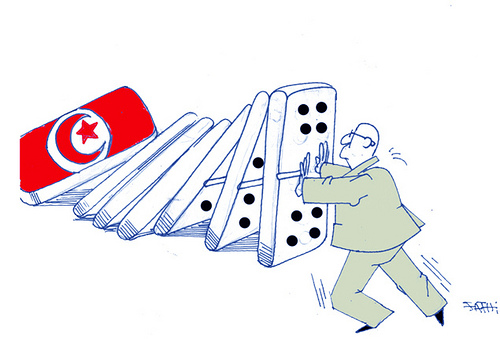
Will protests have domino effect in Arab World?


The Arab world has been transfixed by the recent dramatic events in Egypt and Tunisia. Popular street protests have swept across Egypt just days after similar protests saw Tunisia's President Zine al-Abidine Ben Ali flee his country. Could a domino effect sweep more leaders from power as it did around Eastern Europe in 1989?

After the Jasmin Revolution in Tunis, Egypt may face with a revolution against the governance of President Hosni Mubarak. The head of state, President Hosni Mubarak has been in power since 1981. 

Having difficulty in coping with corruption, increasing living expenses, and effects of global financial crisis are main elements of economic variables. Authoritarianism, nepotism, bad relations between government and opposition and shifting elites are the political variables. Hegemony of dominant powers on politically and economicly weak but geopolitically important countries in the region is international variable. All of these variables and elements form the dynamics of regime change.  

`As in Tunisia, Egyptians face tough economic conditions, official corruption and little opportunity to express their dissatisfaction with the political system ` (BBC, 2011). As a result of this, huge protests continue in Cairo's Tahrir Square, but President Mubarak stands resolute.

Mubarak says to transfer power but not resigning on last night. He says that he was delegating his powers to his Vice President Omar Suleiman.
Suleiman, a 74-year-old former intelligence chief who was promoted just last month, is not widely popular with protesters who are seeking a complete break with the military-dominated system that has governed Egypt for the past six decades` (Reuters, 2011)

Why Egypt is important for the Middle East? 


Egyptian stability is important for Mideast peace. The Camp David Accords were signed by Egyptian President Anwar El Sadat and Israeli Prime Minister Menachem Begin on September 17, 1978, following thirteen days of secret negotiations at Camp David. This Framework for the Conclusion of a Peace Treaty between Egypt and Israel, led directly to the 1979 Egypt-Israel Peace Treaty. In addition to this, Egypt is a key partner in the search for peace in the Middle East and resolution of the Israeli-Palestinian conflict. 


Moreover, Egypt played an important role in the negotiations leading to the Madrid Conference of 1991, which, under United States and Russian sponsorship, brought together all parties in the region, including for the first time a Palestinian delegation, to discuss Middle East peace. 


This support has continued to the present, with President Hosni Mubarak often intervening personally to promote peace negotiations. In 1996, he hosted the Sharm El-Sheikh "Summit of the Peacemakers" attended by President Bill Clinton and other world leaders. 


In 2000, he hosted two summits at Sharm El-Sheikh and one at Taba in an effort to resume the Camp David negotiations suspended in July 2000, and in June 2003, Mubarak hosted President George W. Bush for another summit on Middle East peace process. Another summit was convened in Sharm El Sheik in early 2005, which was attended by Egypt, Israel, the Palestinian Authority and Jordan. The Egyptian Chief of Intelligence, General Omar Suleiman, has played a substantial role in negotiations between the Israeli and Palestinian sides and is highly respected on both sides.  


Consequently, if Egypt fails to suppy stability within the country, this make a domino effect as it did around Eastern Europe in 1989. 


From Jasmine to the Nile Revolution: Who is Next?


Yemen, Algeria, Syria, Libya, Jordan, Morocco, and Kuwait may face with a revolution or unrest  after resign or transfering power of Tunisian President Ben Ali and Egyptian President Mubarak. 

Yemen, the head of state is President Ali Abdullah Saleh, 64. He has been in power since 1978. President anounces he will quit in 2013. 

Algeria, the head of state is Abdelaziz Bouteflika, 73. He has been in power since 1999. There are protests on the streets, but President Bouteflika presides over coalition.  

Syria, the head of state is Bashar al-Assad, 45. He has been in power since 2000. He is son of former president of Syria, Hafea al-Assad. Protests are suppressed. 

Libya, the head of state is Muammar Gaddaffi, 68. He has been in power since 1969. No opposition to Gaddafi due to traditional divisions in population. 

Jordan, the head of state is King Abdullah II, 49. He has been in power since 1999. King sacks his government on 1 February and ordered new Prime Minister Marouf Bakhit to carry out political reforms.

Morocco, the head of state is King Mohammed VI, 47. He has been in power since 1999. 

Kuwait, the head of state is Sheikh Sabah IV Al-Ahmad Al-Jaber Al-Sabah since 2006. Kuwait is a constitutional monarchy. Hereditary monarchy, Kuwait could see unrest. 

Saturday, January 29, 2011

Mubarak dismisses government


Embattled Egyptian leader says he will name a new government on Saturday.

The Egyptian president has dismissed his government, saying that he will replace it with a new one on Saturday.

"I have asked the government to resign and tomorrow there will be a new government," Hosni Mubarak said in an address to the nation late on Friday after four days of deadly protests.

The president said that change can not be achieved through chaos but through dialogue.

Saying he understood that the people of Egypt wanted him to address poverty, employment and democratic reform, he promised to press ahead with social, economic and political reforms.

"We will not backtrack on reforms. We will continue with new steps which will ensure the independence of the judiciary and its rulings, and more freedom for citizens," Mubarak said.

He said new steps will be taken "to contain unemployment, raise living standards, improve services and stand by the poor."

Reacting to the protests that have erupted in the capital and other cities, Mubarak urged calm, adding that only because of his own reforms over the years, were people able to protest.

'Not enough'

Al Jazeera's Ayman Mohyeldin, reporting from Cairo, said many Egyptians calling for change would say the sacking of the government is not enough.

"Ultimately in Egypt, the power lies with the president," he said.

"On paper, you have an independent parliament and an independent judiciary but every Egyptian will tell you that at the end of the day, power is concentrated in the hands of the president.

"Very few institutions can challenge his authority so the sacking of the cabinet is not going to end the grievances of the people."

(AJE)