Women Rights In Turkey

In its less visible, more subtle forms, gender-based violence threatens the physical and emotional integrity of millions of women living in Turkey, and billions globally

TURKISH - CHINESE RELATIONS SINCE 1971 AND THE EAST TURKISTAN ISSUE

Turkish and Chinese people have historical relations since the periods of the Hun Empire and Göktürks. These relationships are driven, sometimes friendly and sometimes went to war in the history

Monday, February 10, 2014

Start of EU Membership Negotiations With Serbia and The European Integration of Western Balkans


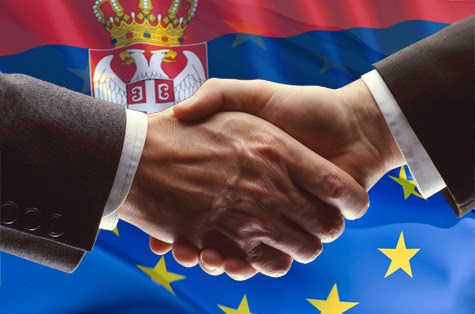
After the collapse of the Soviet Union, organizations such as the European Union (EU) and the NATO increase their activities in the Balkans, and the former Communist Bloc started to join these organizations as their members. In this process, Croatia became the latest member of the EU on 1 July 2013. On 21 January 2014, Serbia began negotiations for EU membership.


Serbia towards the EU...
Along with 5 other Western Balkans countries, Serbia was identified as a potential candidate for EU membership during the Thessaloniki European Council summit in 2003. In 2008, a European partnership for Serbia was adopted, setting out priorities for the country's membership application, and in 2009 Serbia formally applied. In March 2012 Serbia was granted EU candidate status. In September 2013 a Stabilization and Association Agreement between the EU and Serbia entered into force. In line with the decision of the European Council in June 2013 to open accession negotiations with Serbia, the Council adopted in December 2013 the negotiating framework and agreed to hold the 1st Intergovernmental Conference with Serbia in January 2014. On 21 January 2014, the 1st Intergovernmental Conference took place, signaling the formal start of Serbia's accession negotiations.


The EU Membership negotiations are difficult to predict in advance how long one but as one of the Western Balkan counties and one of the former Yugoslav countries, Croatia's full membership negotiations with the EU lasted about six years .


Start of EU Membership Negotiations with Serbia is very important in terms of spreading the peace, democracy and the EU standards throughout all of Europe. Well, the EU membership for Serbia is an easy and convenient way? As each of candidate countries, Serbia is required to complete 35 chapters. Serbia's priorities in order to complete this chapter is required to make constitutional changes and reforms. As in all the Balkan countries, Serbia has some problems on democracy, corruption, minority rights and freedom issues. In addition, as Serbia does not recognize Kosovo's independence, this is also a problem. Thus, Serbia's accession process does not seem like an easy way.


Why Serbia wants to join the EU?
There are several reasons. The first and the most important reason is economic stability. The rate of unemployment is the biggest problem in Serbia. PM of Serbia, Ivica Dacic said, referring to Serbia's 25% unemployment rate, which sits below only Spain and Greece in the EU. The other reasons are higher standard of living, better law, less corruption, more opportunities in education, technological advancement, and free EU funds such as IPA. The second level of benefits is energy stability, EU law as member's protection in many aspects, no visa....
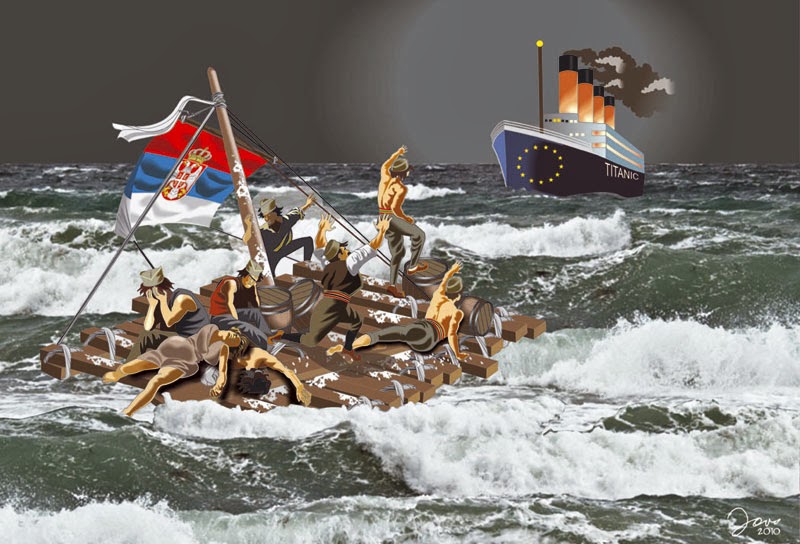

The EU is huge market. EU membership is a chance for Serbia to join the world's largest trading bloc and will offer access to funding for infrastructure projects and the country's poorer regions.


Serbia can join the EU without Recognizing of Kosovo?
On Tuesday, January 21, 2014, after the start of Serbia's accession negotiations with the EU, Kosovo issue has come directly to mind. Serbian President Tomislav Nikolic said that his country will not recognize Kosovo's independence as the price for entering the European Union.
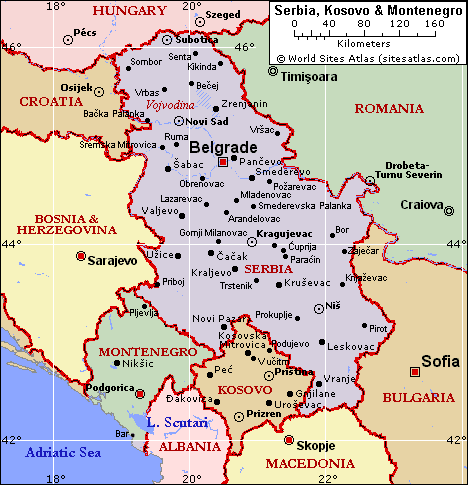

While "normalization" of ties between Serbia and Kosovo is a key criterion for each side's hopes of European integration, MEPs remain divided on whether “normalized" relations must include mutual diplomatic recognition. Ulrike Lunacek, European Parliament rapporteur for Kosovo, on Monday that Serbia would have to recognize the independence of its former province before joining the EU because the club does not want “a second Cyprus. “Even the non-recognizers [of Kosovo's independence] won’t accept Serbia in the EU if Serbia does not recognize it [Kosovo] because that would mean something like Cyprus,” she added. The EU allowed Cyprus to join in 2004 although the island remains divided into Greek and Turkish areas. Many European politicians have since described this as a mistake, as the Cyprus government has used its position inside the EU to isolate Turkish Cypriots. “The ideal thing would be to have both countries joining at the same time," the MEP said, referring to Kosovo and Serbia.
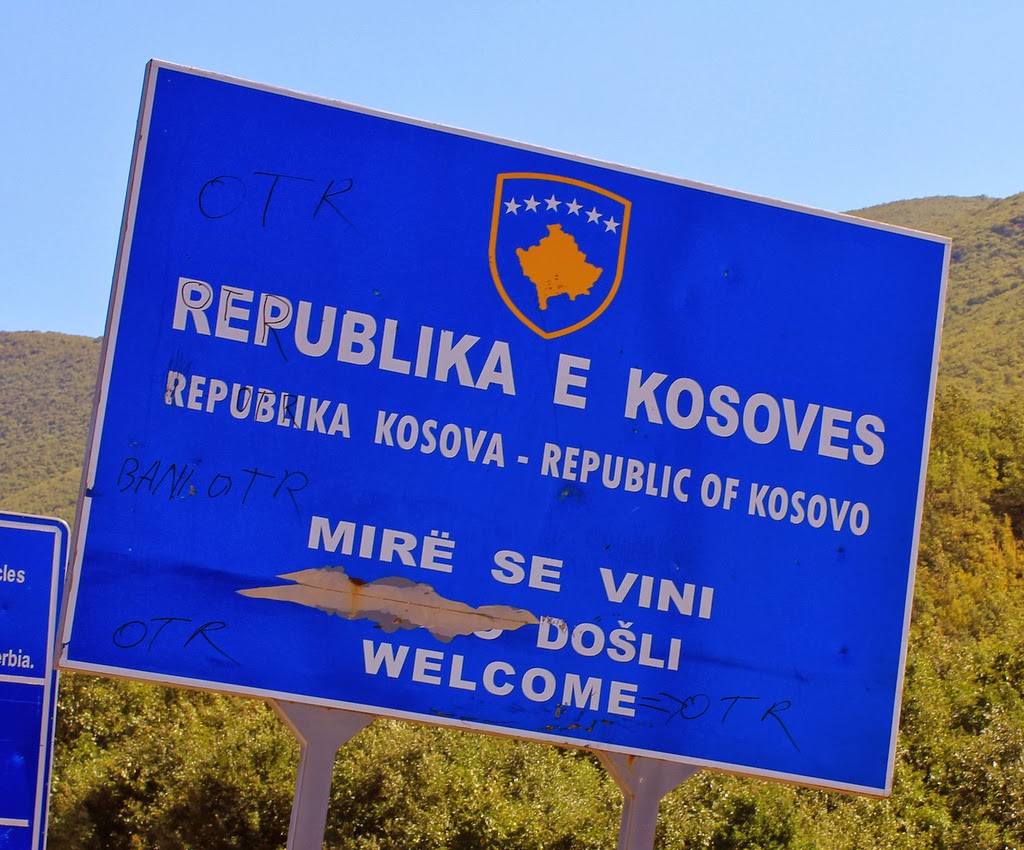

Serbia expects everything positive from the EU, except Kosovo - a hot potato in the mouth. Kosovo got independency, someone should accept in Belgrade. It's not possible overnight. As you know economic stability is primary reason of EU membership. There will not be easy to become member, there are many things to do. What can they lose? Kosovo? It's already independent. Actually Serbia could not control Kosovo for almost a three decade. They have border with Albania, but Kosovars didn't cooperate in anything.


Is there any other option for Serbia except EU membership in its foreign policy?
Right now, it seems there is no another option. Russia is far and didn't invest so much in Serbia, Greece is in debt. Who will help? Milosevic try to walk alone and gave up.


Does Russia support Serbia's Eu membership?
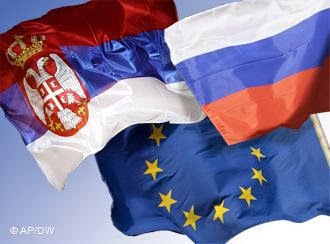
Yes, why not? It's better to sell expensive gas to EU and young members or candidates. Russia only does not support Serbian NATO membership. The enlargement process of the EU continues, and the Union's eastern border has reached to the Balkan countries and the Black Sea. During the Cold War, Russia saw Balkans as backyard is a fact. Primarily need to mention here is that the Russia's Cold War tactics that will not be very effective in the Balkans today, because Russia has not a good offer for Balkan countries to be an alternative for EU.

However, Russia has not given up her interests in the Balkans. The EU aims to diversify away from Russian natural gas supplies, but Russian gas supplies destined for Europe will pass directly through the Balkans. Thus, Russia will continue to remain Europe's primary energy supplier.
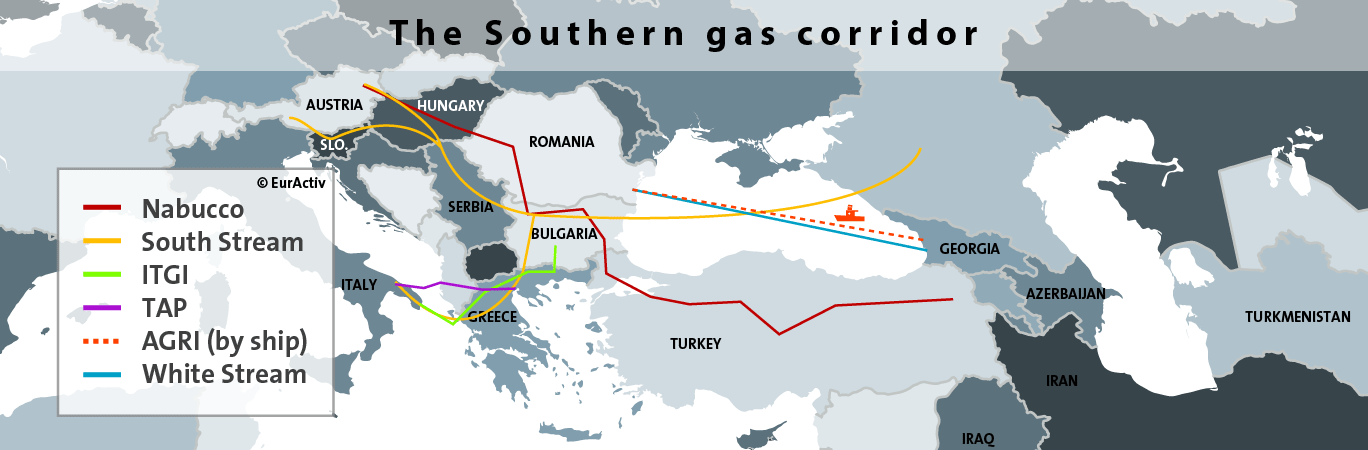

Moreover, Serbia cannot be an island inside the EU. Switzerland is exception with reason. Russia intend to have own player inside EU. Why to do that? Gas is very expensive now. In last 10 years, the price was going up for 70-100%.


If Serbia joins to Eu, how it will affect Western Balkans?
You cannot be new member and immediately spread some negative things, but if Serbia joins to the EU, Western Balkans positively affected by this imminent event. Serbia’s EU Membership can provide more stability in this region.


 İsa Burak GONCA


References

European Commission, “Enlargement: Serbia”, 2014,

JOY, Oliver “Serbian Prime Minister: We will be next to join European Union”, CNN, 2013, 

Kosovo Compromise, “Serbia Must Recognise Kosovo to Join EU, MEP”, 2014, 

RUPNIK,  Jacques, “The Western Balkans and The EU: The hour of Europe”, Chaillot Papers, June 2011


Wednesday, July 17, 2013

The European Union Institutions and Their Functions


Unlike other international organizations, the European Union, just as a state, has several institutions.  

Even looking at the EU's institutions, realizes that her uniqueness. 

 
According to the Article 13 of the Treaty of the European Union, the European Union's institutions shall be:

  • The European Parliament
  • The European Commission
  • The Council of the European Union
  • The European Council
  • Court of Justice of the European Union
  • The European Court of Auditors
  • The European Central Bank
  • Other institution, body and Agencies


In the EU's unique institutional set-up:
  • the EU's broad priorities are set by the European Council, which brings together national and EU-level leaders
  • directly elected MEPs represent European citizens in the European Parliament
  • the interests of the EU as a whole are promoted by the European Commission, whose members are appointed by national governments
  • governments defend their own country's national interests in the Council of the European Union.

Setting the agenda

The European Council sets the EU's overall political direction – but has no powers to pass laws. Led by its President – currently Herman Van Rompuy – and comprising national heads of state or government and the President of the Commission, it meets for a few days at a time at least every 6 months.

Law-making

There are 3 main institutions involved in EU legislation:
  • the European Parliament, which represents the EU’s citizens and is directly elected by them;
  • the Council of the European Union, which represents the governments of the individual member countries. The Presidency of the Council is shared by the member states on a rotating basis.
  • the European Commission, which represents the interests of the Union as a whole.
Together, these three institutions produce through the "Ordinary Legislative Procedure" (ex "co-decision") the policies and laws that apply throughout the EU. In principle, the Commission proposes new laws, and the Parliament and Council adopt them. The Commission and the member countries then implement them, and the Commission ensures that the laws are properly applied and implemented.
Decision-making in the EU – more on EU law-making procedures

Other EU institutions

Two other institutions play vital roles:
The powers and responsibilities of all of these institutions are laid down in the Treaties, which are the foundation of everything the EU does. They also lay down the rules and procedures that the EU institutions must follow. The Treaties are agreed by the presidents and/or prime ministers of all the EU countries, and ratified by their parliaments.


Wednesday, July 10, 2013

The Global Corruption Barometer 2013 Announced

Transparency International asked over 114,000 people in 107 countries for their views on corruption.


More than half of people believe the level of corruption in their countries has increased over the past two years, according to the world's largest public opinion survey on the subject.  

Here is the Global Statistics by Transparency International:


 For more information: http://www.transparency.org/


Monday, July 8, 2013

Dramatic History of Europe and the Emergence of the European Union


Europe is one of the world's seven continents where approximately 740 million people living in. It is the world's second-smallest continent by surface area, covering about 10,180,000 square kilometres (3,930,000 sq mi) or 2% of the Earth's surface and about 6.8% of its land area. Everything in this small continent was not nearly as positive and stable, because there was seen at least one major war between nations of Europe in every hundred years.  
World War II Deaths
Before the establishment of the European Union, it is known that the nations of Europe fought constantly with each other. In fact, some of the largest and bloodiest wars in the history of the world has existed on this continent such as World War I, World War II, Thirty Years' War, Napoleonic Wars, and French Wars of Religion.  

Franco-German Wars
In addition, France and Germany fought three times between 1870 and 1945. With the end of the Second World War in Europe, millions of people have died, and the states of Europe had collapsed economically.

Finally people understood that the wars between the European nations always damaging to Europe.

At this point, the idea of ​​the unity of the European states began to emerge.

In the 17th century, Immanuel Kant, Saint Simon, Wiliam Penny, Maximillian Jully and Victor Hugo that make up the infrastructure of this idea, and believes that one day the European union would be realized.

In fact, in 1856, by the Treaty of Paris was signed by five European countries, an alliance which is called as the Concert of Europe was founded.

The term of "United States of Europe" which was invented during the 19th century, and frequently used by the Austrian statesman Coudenhove-Kalergi, and French politician Briand in the 20th century.

Of course, all of these efforts collapsed with the rise of fascism especially in Germany and Italy in the 1930s. After the World War II, European people united around the idea of "Never Again War". 

In addition to the social and economic reasons, another factor for the acceleration of the process of formation of the European Union has been the aggressive policy of the Soviet Union.

Zürich, Switzerland
The term "United States of Europe" was used also by Winston Churchill in his speech delivered on 19 September 1946 at the University of Zürich, Switzerland. In this speech given after the end of the Second World War, Churchill concluded that:

"We must build a kind of United States of Europe. In this way only will hundreds of millions of toilers be able to regain the simple joys and hopes which make life worth living".


In 1949, the Council of Europe was founded . It is an international organisation promoting co-operation between all countries of Europe in the areas of legal standards, human rights, democratic development, the rule of law and cultural co-operation. It has 47 member states with some 800 million citizens.


Jean Monnet Father of Europe
Of course we should not forget the efforts of Jean Monnet who is the father of Europe. Following World War II, France was in severe need of reconstruction and completely dependent on coal from Germany's main remaining coal-mining areas, the Ruhr and Saar areas. In 1945 Monnet proposed the Monnet Plan, also known as the "Theory of l'Engrenage" (not to be confused with the Schuman plan). It included taking control of the remaining German coal-producing areas and reditecting the production away from the German industry and into the French, thus permanently weakening Germany and raising the French economy considerably above its pre-war levels. The plan was adopted by Charles de Gaulle in early 1946.

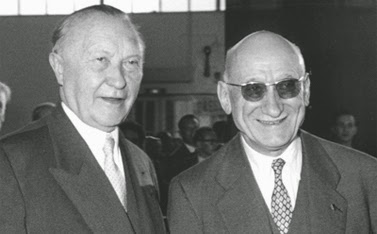
Konrad Adenauer & Robert Schuman
When tensions between France and Germany rose over the control of the then vital coal and steel industries, Monnet and his associates conceived the idea of a European Community. On 9 May 1950, with the agreement of Chancellor Konrad Adenauer of West Germany, French Minister of Foreign Affairs Robert Schuman made a declaration in the name of the French government. This declaration, prepared by Monnet for Schuman, proposed integration of the French and German coal and steel industries under joint control, a so-called High Authority, open to the other countries of Europe. Schuman declared:
"Through the consolidation of basic production and the institution of a new High Authority, whose decisions will bind France, Germany and the other countries that join, this proposal represents the first concrete step towards a European federation, imperative for the preservation of peace."
European Coal and Steel Community
When Germany agreed to join the European Coal and Steel Community according to the Schuman Plan in 1951, the ongoing dismantling of German industry was halted and some of the restrictions on German industrial output were lifted. West Germany joined the ECSC, alongside Italy, Belgium, Luxembourg and the Netherlands, while Britain refused, on grounds of national sovereignty. In 1952, Jean Monnet became the first president of the High Authority and with the opening of the common market for coal under the ECSC in 1953, the last civilian production limitations placed on German industry were lifted, and the role of the IAR was taken over by the ECSC.

European Coal & Steel Community Flag
The ECSC was first proposed by French foreign minister Robert Schuman on 9 May 1950 as a way to prevent further war between France and Germany. He declared his aim was to "make war not only unthinkable but materially impossible." The means to do so, Europe's first supranational community, was formally established by the Treaty of Paris (1951), signed not only by France and West Germany, but also by Italy and the three Benelux states: Belgium, the Netherlands and Luxembourg. Between these states the ECSC would create a common market for coal and steel. The ECSC was governed by a "High Authority", checked by bodies representing governments, MPs and an independent judiciary.
The ECSC was joined by two other similar communities in 1957 with Treaty of Rome, EEC and EURATOM, with whom it shared its membership and some institutions. In 1967 all its institutions were merged with that of the European Economic Community (EEC, which later became part of the European Union), but it retained its own independent identity.

The Merger Treaty (1967) (or Brussels Treaty) was a European treaty which combined the executive bodies of the European Coal and Steel Community (ECSC), European Atomic Energy Community (Euratom) and the European Economic Community (EEC) into a single institutional structure.

On 1 July 1968, six countries – Belgium, France, Germany, Italy, Luxembourg and Holland – abolished the last duties on goods movements among themselves, creating a European customs union. Besides doing away with trade barriers between member countries of what has become the European Union, the customs union established a common tariff on all goods entering these countries.

Charles de Gaulle

French president Charles de Gaulle strongly resisted, arguing that the UK was closer to American policies than European ones, and would therefore attempt to "sabotage" the community. Consequently, France vetoed the UK's first attempt at achieving membership in 1963, and in 1967.

Of course, the expansion of the 1970s and 1980s, was important steps for the European Union. In 1973, the Communities enlarged to include Denmark (including Greenland, which later left the Community in 1985), Ireland, and the United Kingdom. Norway had negotiated to join at the same time, but Norwegian voters rejected membership in a referendum. In 1979, the first direct, democratic elections to the European Parliament were held. Greece joined in 1981; Portugal and Spain in 1986. In 1985, the Schengen Agreement led the way toward the creation of open borders without passport controls between most member states and some non-member states. In 1986, the European flag began to be used by the Community and the Single European Act was signed.

The Single European Act (SEA) was the first major revision of the 1957 Treaty of Rome. The Act set the European Community an objective of establishing a Single market by 31 December 1992, and codified European Political Cooperation, the forerunner of the European Union's Common Foreign and Security Policy. It was signed at Luxembourg on 17 February 1986, and at The Hague on 28 February 1986. It came into effect on 1 July 1987, under the Jacques Delors Commission.

Helmut Kohl & François Mitterrand
The European Union was formally established when the Maastricht Treaty—whose main architects were Helmut Kohl and François Mitterrand. 1992-1993 The Maastricht Treaty (formally, the Treaty on European Union or TEU) was signed on 7 February 1992 by the members of the European Community in Maastricht, Netherlands. On 9–10 December 1991, the same city hosted the European Council which drafted the treaty. Upon its entry into force on 1 November 1993 during the Delors Commission, it created the European Union and led to the creation of the single European currency, the Euro. The Maastricht Treaty has been amended by the treaties of Amsterdam, Nice and Lisbon. 


In 1995, Austria, Finland, and Sweden joined the EU. In 2002, Euro banknotes and coins replaced national currencies in 12 of the member states. Since then, the Eurozone has increased to encompass 17 countries. In 2004, the EU saw its biggest enlargement to date when Cyprus, the Czech Republic, Estonia, Hungary, Latvia, Lithuania, Malta, Poland, Slovakia, and Slovenia joined the Union. On 1 January 2007, Romania and Bulgaria became EU members. In the same year Slovenia adopted the euro, followed in 2008 by Cyprus and Malta, by Slovakia in 2009, and by Estonia in 2011.

On 1 December 2009, the Lisbon Treaty entered into force and reformed many aspects of the EU. In particular, it changed the legal structure of the European Union, merging the EU three pillars system into a single legal entity provisioned with a legal personality, created a permanent President of the European Council, the first of which was Herman Van Rompuy, and strengthened the High Representative, Catherine Ashton.

Herman Van Rompuy & Catherine Ashton


The European Union received the 2012 Nobel Peace Prize for having "contributed to the advancement of peace and reconciliation, democracy, and human rights in Europe." On 1 July 2013, Croatia became the 28th EU member.
 
Although the monetary union has been shaken by the European sovereign-debt crisis since 2009 and Accession of Cyprus to continue the controversial, the European Union still has its own unique and unparalleled in the world. Thanks to the European Union, bloody wars ended in Europe today.